Alignment#
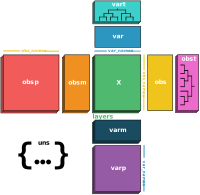
By default, obs_names and var_names are aligned to the leaves of trees stored in obst and vart. However, treedata.TreeData supports multiple alignment types which can be declared using the alignment parameter.
leaves: All leaf names must be present in the observation/variable names.nodes: All leaf and internal node names must be present in the observation/variable names.subset: A subset of leaf and internal node names are present in the observation/variable names.
This tutorial explains these alignment types and how they effect subset and concatenation behavior.
import networkx as nx
import numpy as np
import pandas as pd
import treedata as td
import warnings
import matplotlib.pyplot as plt

warnings.formatwarning = lambda msg, *args, **kwargs: f"{msg}\n"
def plot_tree(tree, color_attr=None):
    """Helper function for plotting trees."""
    plt.figure(figsize=(6, 3))
    node_colors = "lightgrey" if color_attr is None else [tree.nodes[node].get(color_attr) for node in tree.nodes()]
    pos = nx.drawing.nx_agraph.graphviz_layout(tree, prog="dot")
    nx.draw(tree, pos, with_labels=False, node_size=100, node_color=node_colors)
    leaf_nodes = [node for node in tree.nodes() if tree.out_degree(node) == 0]
    for node, (x, y) in pos.items():
        if node in leaf_nodes:
            plt.text(x, y + 10, s=node, rotation=90, fontsize=8, ha="center", va="top")
        else:
            plt.text(x, y, s=node, fontsize=8, ha="center", va="center")
    plt.show()
Leaf alignment#
The leaves alignement is intended for experiments where only the leaves of the tree are observed such as CRISPR-based single-cell lineage tracing.
tree = nx.balanced_tree(r=2, h=4, create_using=nx.DiGraph)
tree = nx.relabel_nodes(tree, {i: str(i) for i in tree.nodes()})
leaves = [i for i in tree.nodes if tree.out_degree(i) == 0]
tdata = td.TreeData(obs=pd.DataFrame(index=leaves), obst={"tree": tree})
print("Observations: ", list(tdata.obs_names))
print("Alignment: ", tdata.alignment)
plot_tree(tdata.obst["tree"])
Observations:  ['15', '16', '17', '18', '19', '20', '21', '22', '23', '24', '25', '26', '27', '28', '29', '30']
Alignment:  leaves
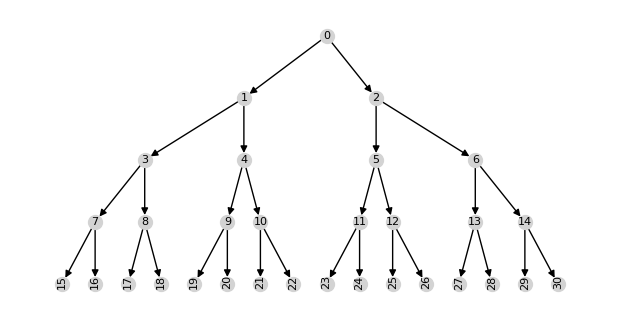
Subsetting yields the tree induced by the selected leaves and their ancestors.
tdata1 = tdata[:8]
tdata2 = tdata[8:]
print("Observations: ", list(tdata1.obs_names))
print("Alignment: ", tdata1.alignment)
plot_tree(tdata1.obst["tree"])
Observations:  ['15', '16', '17', '18', '19', '20', '21', '22']
Alignment:  leaves
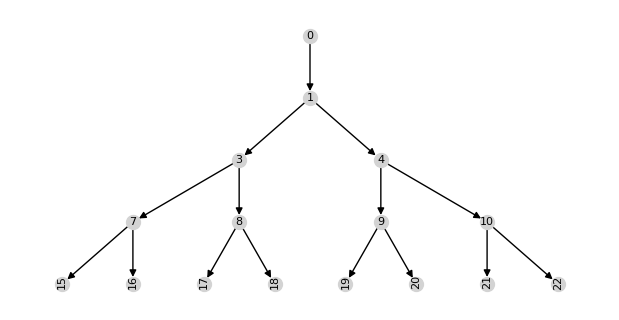
Concatenation yields the tree generated by taking the union of nodes and edges within the listed trees. See the Concatenation tutorial for more details.
tdata = td.concat([tdata1, tdata2], axis=0)
print("Observations: ", list(tdata.obs_names))
print("Alignment: ", tdata.alignment)
plot_tree(tdata.obst["tree"])
Observations:  ['15', '16', '17', '18', '19', '20', '21', '22', '23', '24', '25', '26', '27', '28', '29', '30']
Alignment:  leaves
Node alignment#
The nodes alignment is designed for experiments were all nodes in the tree are observed such as live-cell imaging.
nodes = tree.nodes
tdata = td.TreeData(obs=pd.DataFrame(index=nodes), obst={"tree": tree}, alignment="nodes")
print("Observations: ", list(tdata.obs_names))
print("Alignment: ", tdata.alignment)
plot_tree(tdata.obst["tree"])
Observations:  ['0', '1', '2', '3', '4', '5', '6', '7', '8', '9', '10', '11', '12', '13', '14', '15', '16', '17', '18', '19', '20', '21', '22', '23', '24', '25', '26', '27', '28', '29', '30']
Alignment:  nodes
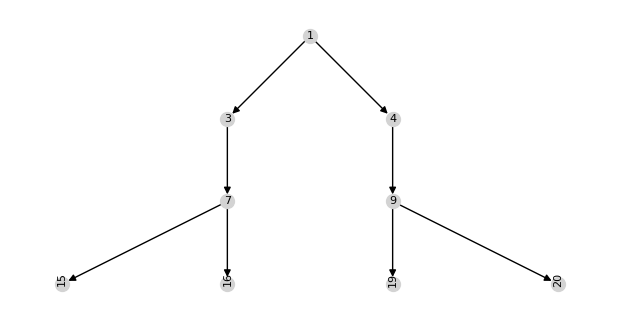
Subsetting yields the tree containing the selected nodes as long as that tree is fully connected.
tdata1 = tdata[["1", "3", "4", "7", "9", "15", "16", "19", "20"]]
print("Observations: ", list(tdata1.obs_names))
print("Alignment: ", tdata1.alignment)
plot_tree(tdata1.obst["tree"])
Observations:  ['1', '3', '4', '7', '9', '15', '16', '19', '20']
Alignment:  nodes
If the subset is not fully connected, subsetting will result in a warning and tdata object will be switched to alignment='subset'.
tdata2 = tdata[["0", "3", "4", "27"]]
print("Observations: ", list(tdata2.obs_names))
print("Alignment: ", tdata2.alignment)
plot_tree(tdata2.obst["tree"])
Observations:  ['0', '3', '4', '27']
Alignment:  subset
Since a valid tree cannot be generated by concatenating trees with distinct nodes, concatenation will use the specified merge strategy to select one of the trees to return.
tdata = td.concat([tdata[["1", "3", "4", "7", "9", "15", "16", "19", "20"]], tdata[["0", "2"]]], axis=0, merge="first")
print("Observations: ", list(tdata.obs_names))
print("Alignment: ", tdata.alignment)
plot_tree(tdata.obst["tree"])
Observations:  ['1', '3', '4', '7', '9', '15', '16', '19', '20', '0', '2']
Alignment:  nodes
Subset alignment#
The subset alignment is the most flexible, allowing for arbitrary subsets of leaves and nodes to be observed.
nodes_subset = np.random.choice(list(tree.nodes()), size=10, replace=False)
tdata = td.TreeData(obs=pd.DataFrame(index=nodes_subset), obst={"tree": tree}, alignment="subset")
print("Observations: ", list(tdata.obs_names))
print("Alignment: ", tdata.alignment)
plot_tree(tdata.obst["tree"])
Observations:  ['25', '28', '15', '17', '30', '5', '26', '3', '29', '27']
Alignment:  subset
Subsetting does not effect the tree topology
tdata1 = tdata[["25", "28", "15", "17"]]
tdata2 = tdata[["30", "5", "26", "3", "29", "27"]]
print("Observations: ", list(tdata1.obs_names))
print("Alignment: ", tdata1.alignment)
plot_tree(tdata1.obst["tree"])
Observations:  ['25', '28', '15', '17']
Alignment:  subset
Similar to the nodes alignment, concatenation will use the specified merge strategy to select one of the trees to return.
tdata = td.concat([tdata1, tdata2], axis=0, merge="first")
print("Observations: ", list(tdata.obs_names))
print("Alignment: ", tdata.alignment)
plot_tree(tdata.obst["tree"])
Observations:  ['25', '28', '15', '17', '30', '5', '26', '3', '29', '27']
Alignment:  subset
Switching alignment type#
The alignment type can be changed by setting the alignment parameter as long as the alignment is compatible with the observed data.
tdata = td.TreeData(obs=pd.DataFrame(index=leaves), obst={"tree": tree})
print("Observations: ", list(tdata.obs_names))
print("Alignment: ", tdata.alignment)
Observations:  ['15', '16', '17', '18', '19', '20', '21', '22', '23', '24', '25', '26', '27', '28', '29', '30']
Alignment:  leaves
Valid transition:
tdata.alignment = "subset"
print("Observations: ", list(tdata.obs_names))
print("Alignment: ", tdata.alignment)
Observations:  ['15', '16', '17', '18', '19', '20', '21', '22', '23', '24', '25', '26', '27', '28', '29', '30']
Alignment:  subset
Invalid transition:
try:
    tdata.alignment = "nodes"
except ValueError as e:
    print(e)
print("Alignment: ", tdata.alignment)
One or more trees in `obst` cannot be transitioned to nodes alignment.
Alignment:  subset